

Custom Signage Engraving Plastic Factory: Your Partner for High-Quality Engraved Signs
2026-10-22
Most signs fail quietly—a crack at the mounting hole, fading text, an edge that looks fine until it’s installed. That’s why custom plastic engraving still beats shortcut manufacturing. LYSHIRE treats every engraved sign as a small engineering problem: substrate, depth, finish, and readability all have to line up. If you’re sourcing signs that need to hold up under real conditions, this guide will show you what to look for before you commit.
Engraved Plastics That Keep Their Edge in the Field
In demanding outdoor and industrial environments, engraved plastic tags and panels are often the last thing anyone thinks about until a label fails. The best options use multilayer acrylic or phenolic substrates, where the engraved characters cut through a contrasting top layer to reveal a core that won't rub off, fade, or wash away. That means field crews can still read a serial number or safety warning years after installation, even after exposure to solvents, UV light, and constant handling.
What separates ordinary engraved plastics from ones that keep their edge is the combination of material hardness and engraving depth. Softer plastics may be cheaper to machine, but their lettering tends to blur at the edges under repeated impact or chemical contact. High-density polyethylene and glass-reinforced epoxy sheets, on the other hand, hold a crisp bevel that resists chipping. This matters in places like construction sites, marine decks, and chemical processing plants, where tags get scraped by tools, pressure-washed, or splashed with hydraulic fluid. A well-cut tag doesn't just survive; it stays legible enough to do its job.
Another advantage is that engraving isn't a surface treatment. Printed graphics rely on an ink layer that can peel, crack, or be scraped away, but an engraved mark is a physical recess. Even if the surrounding area becomes dulled or stained, light still catches the cut edges, making text readable from a distance. For equipment that stays in service for a decade or more, that kind of passive durability removes the need for relabeling and keeps compliance information right where it belongs.
From Your Vector File to a Sign That Fits the Space
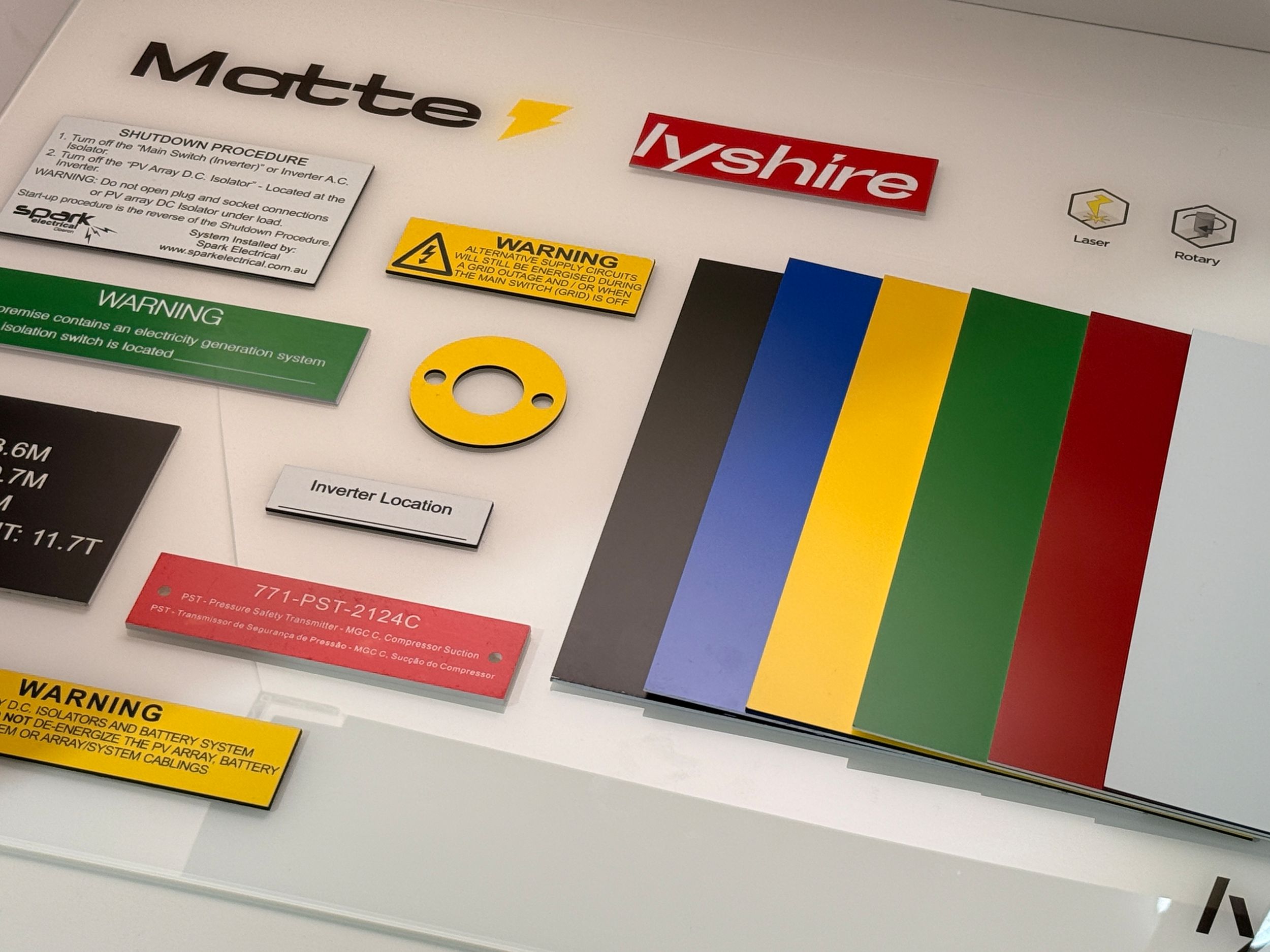
Scaling a vector file up to sign size rarely works by simply dragging a corner handle. What looks balanced on a monitor at 4 inches wide can fall apart at 8 feet. Curves get visually thinner, letterforms start to look stretched, and elements that were nicely spaced suddenly bunch together at the top. So we begin by setting the actual viewing distance and reworking the internal rhythm of the design—tightening gaps where needed, letting key elements breathe, and sometimes removing detail that won't survive at that scale.
Then there's the physical space itself. A sign above a doorway has to deal with the door frame, the ceiling height, and the angle people approach from. We'll adapt the artwork to the surface texture and available mounting points, leaving a margin that feels intentional rather than accidental. If the wall has a slight curve or an uneven seam, the design shifts slightly to keep everything optically straight from the main sightline.
Days later, when the sign is up, the vector file is almost an afterthought. The sign now feels like part of the room—not a printout stuck to the wall, and not a piece of branding trying too hard. That's the difference between having artwork that exists and a sign that actually fits.
No Middlemen, Just the Factory Floor and Your Specs
When your order goes straight to the factory floor, the only translation between your spec sheet and the final product is the one made by the machinist or assembler reading it. No sales rep paraphrasing, no distributor rekeying your measurements, no office assistant guessing at tolerances. You send the drawing or the sample, and the person who sets up the machine works from that exact input.
That direct line does more than cut cost. It cuts confusion. A change to a finish, a different thread spec, a tweak to packaging—these get handled in a single exchange with the production team, not a week of emails through a chain of intermediaries. And when something goes wrong, accountability stays where it belongs: on the floor, not buried in a contract between two middlemen.
Color, Texture, and Depth That Match the Mockup
Nailing the exact shade from a mockup often comes down to the small, unglamorous choices: swapping a pure black for a charcoal that carries a hint of the background hue, or muting a bright accent until it sits quietly in the same visual family. Subtle temperature shifts—warm grays against cool blues, for example—can pull a digital composition together far more effectively than a literal color pick.
Texture works the same way. A flat fill might reproduce the layout, but it misses the tactile cues that make a design feel finished. Even a faint grain, a soft paper tooth, or a barely-there weave across a button or card can ground the interface in something tangible. The trick is restraint: enough texture to suggest a material, never so much that it competes with the type or the hierarchy.
Depth, too, doesn't need dramatic drop shadows or heavy gradients. It can come from a one-pixel inner highlight on a raised element, a slightly darker edge on an inset panel, or layered translucency that lets a background color breathe through. When color, texture, and depth all pull from the same reference, the screen starts to feel less like a flattened approximation and more like a crafted object.
Tolerances Tight Enough for Instrument Panels
On a modern instrument panel, the visible gaps between the dash, door trim, and center stack rarely exceed half a millimeter. Push that to 0.7 or 0.8 mm and the cockpit immediately feels loose, even if every clip is fully seated. Injection molding throws in enough variation from shrink rates and material batch shifts that the tooling has to be cut with deliberate offsets, not just nominal CAD numbers. Otherwise you end up chasing dimensional drift with shims and foam tape on the line.
Flushness matters just as much as gap width. Where the IP top pad meets the A-pillar garnish, a step of only 0.3 mm can cast a visible shadow line across the windshield in direct sunlight. Most programs lock that surface-to-surface tolerance at ±0.3 mm or tighter for premium trims, which forces the locating features to do double duty: they pull the parts into position while still allowing a little float for build variation. Rely on screw bosses alone and the stack-up will eat the tolerance before the first car leaves the plant.
Temperature swings from -30°C overnight to 80°C under a summer sun make the plastic move more than people expect. Polypropylene and PC/ABS expand at different rates, so a joint that looks perfect at room temperature can squeak or pop loose after a few thermal cycles. The workaround is not to tighten everything down rigidly, but to keep the visible gap stable with locating pins and let hidden attachment points float by a millimeter or so. That balance between tight appearance and forgiving structure is what separates a solid IP from one that creaks over every speed bump.
A Production Partner That Treats Small Orders Like Big Ones
Most factories nod along when you mention a small first run, then quietly push your job behind a larger account. We built our workflow the other way around. Every order gets a named contact, a clear production window, and the same pre-production sample step a bulk buyer would expect. No chasing, no guesswork, just a schedule that holds.
There is no minimum order quantity hidden in the fine print. Small batches go on the same line, with the same inspection checklist, as large ones. If you need to split a shipment or combine two styles into one run, we will make it work without charging like a custom project. That flexibility matters more than most people realize until they are stuck with 900 extra units.
What tends to happen is that a small order becomes a testing ground. You learn how the product moves, what your customers actually want, and whether the fit is right. When you come back with a bigger order, we already know your specs and preferences. Treating the first 100 pieces like the first 10,000 is simply how we keep clients around.
FAQ
We work with a broad range of materials, including acrylic, polycarbonate, ABS, and PVC. Each has its own strengths—acrylic gives a crisp, glossy finish, polycarbonate handles impact well, and ABS is great for indoor durability on a budget. If you're unsure which fits your project, we can recommend based on your environment and design.
Absolutely. Many of our plastics are UV-stabilized and weather-resistant, so they won't fade, crack, or warp easily. For outdoor use, we often suggest cast acrylic or polycarbonate with outdoor-rated engraving paints. With proper installation, you can expect years of service even in direct sun or rain.
Very flexible. You can choose almost any shape, size, color, and font. We do laser engraving, rotary engraving, and even add cut-out letters or braille. If you have a logo or specific brand colors, we can match them closely. Just send us your artwork, and we'll let you know what's possible.
Yes, we have an in-house design team. You can share a rough sketch, a photo, or just an idea. We'll create clean vector files for your approval before production. There's usually a small design fee, but it gets waived on larger orders.
Most standard orders leave our factory within 5 to 8 business days after design approval. Larger or more complex projects with special materials might take 10 to 15 days. If you're in a rush, we do offer expedited production for an extra charge.
Definitely. We're set up for both small runs and high-volume production. Our factory uses CNC engraving and automated laser systems, so we can keep quality consistent across thousands of pieces. We also offer special packaging and drop shipping to individual locations if needed.
We calibrate our machines regularly and run test pieces before every batch. For fine text or intricate logos, we adjust laser power and speed based on material thickness. You can expect sharp edges and consistent depth, with no chipping or melting.
Conclusion
When your project calls for engraved plastic signs that need to survive real-world handling, working directly with a dedicated factory changes the conversation. You send a vector file, specify the dimensions, and the team turns that into a physical sign that fits the intended space without guesswork. There are no intermediaries diluting the details—just the shop floor, your specs, and a process built around material precision. The engraved plastics are chosen to hold a clean edge in the field, resisting wear that would quickly dull lesser alternatives. Color, texture, and depth are matched against your mockup, so what you approved is what gets machined. This direct link from file to finished piece keeps the work consistent and straightforward.
That same discipline applies when the tolerances get tight. For instrument panels or control faces where every line and legend must sit exactly where intended, the factory treats dimensional accuracy as a baseline, not an upsell. Small orders receive the same attention as large runs—your prototype or short batch isn't pushed aside for higher-volume jobs. The result is a production partner that understands signage as a functional component, not just decoration. Engraved plastic signs from this kind of setup feel deliberate: edges are crisp, mounting fits are predictable, and the visual depth matches the design intent. Over time, that reliability becomes the real value, letting you spec custom signage without having to micromanage every step.
Contact Us
Contact Person: Tina Hou
Email: [email protected]
Tel/WhatsApp: +86 17816238685
Website: https://www.lyshire.com