

Stainless Steel Hex Socket Cap Screw Wholesaler Guide to Sourcing Reliable Fasteners
2026-10-01
Finding a stainless steel hex socket cap screw wholesaler who won't ghost you after the first container is harder than it sounds. Plenty of vendors promise precision threads and corrosion resistance, but few can show batch-level traceability, consistent torque specs, or the kind of packaging that survives a trans-Pacific trip. Wanluo built its reputation by treating bulk fasteners as engineered components, not commodities. In this guide, we walk through the real-world checks—material certs, head marking legibility, dimensional tolerances, and lead-time honesty—so you can separate a dependable source from a costly gamble before your next order.
What Separates Quality Stainless Steel Hex Socket Cap Screws from the Rest
A lot of stainless hex socket cap screws fail long before they strip or snap—they simply corrode in places that a genuine 304 or 316 would shrug off. The difference usually comes down to melt chemistry and solution annealing. Cheap imports often use reclaimed steel with nickel and chromium at the low end of the spec, or slightly off-spec altogether. Without proper solution treatment, chromium carbides form at grain boundaries, making the screw susceptible to intergranular attack in damp or mildly acidic environments. Quality fasteners are traceable to a heat number, and the better distributors verify composition with XRF or OES before the parts ever reach your bin.
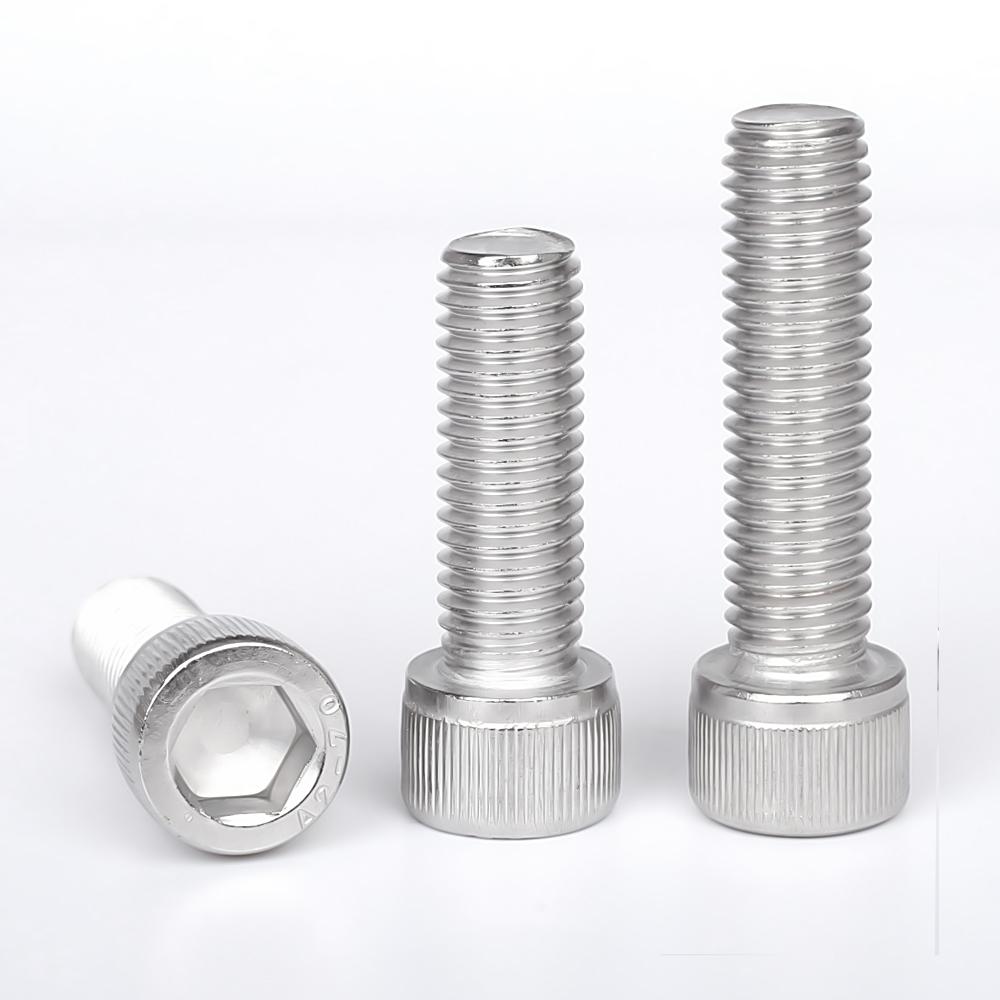
Drive fit and thread form separate the reliable screws from the ones that round out on the first install. A well-made hex socket has clean, sharp corners with a consistent depth and a slight entry chamfer; if the socket is shallow or oversized, the key engages only the top edge and cams out under torque. On the thread side, rolled threads beat cut threads for fatigue resistance because the grain flow follows the thread profile. Quality screws also hold a 6g tolerance across the entire batch, so you don't end up with some holes feeling sloppy and others binding halfway in.
Surface finish is where many supposedly stainless screws give themselves away. A proper passivation bath removes free iron left from cold forming and builds a dense chromium oxide layer. Skip that step, or let the screws rattle around with carbon steel parts, and you get rust staining within weeks—even on “304” material. The best suppliers also keep their inventory dry and sealed, because chlorides from handling or storage can initiate pitting before the fastener is ever installed. It's these small process controls, not just the alloy name, that determine whether a socket cap screw stays clean for years or turns into an eyesore.
Reading a Wholesaler's Spec Sheet Without Missing Critical Details
Wholesale spec sheets often bury the real story in abbreviations, inconsistent units, and fine-print footnotes. Start by scanning the header for order minimums, case pack counts, and lead times — these numbers rarely change, but they set the tone for everything else. Then move to the product dimensions and weight, not just the shipping carton, because a seemingly compact item might require oversized packaging that kills your margin. Pay attention to whether measurements are in inches or centimeters, and whether weight is per unit or per case; mixing these up leads to costly return freight and storage miscalculations.
Next, check the materials and compliance section line by line. Terms like "food-grade silicone," "BPA-free," or "ASTM F963 tested" are not marketing fluff — they indicate whether the item can legally enter certain markets or survive a customs audit. If you see vague language like "high-quality plastic" or "durable fabric," ask for the exact resin grade, GSM weight, or thread count. Also verify the country of origin and any tariff codes listed; a missing HTS code can mean your landed cost estimate is just a guess until the goods hit the port.
Finally, compare the spec sheet against the actual sample or previous purchase order. One common trick: manufacturers list the product's unfolded dimension but ship it folded, changing the carton size and your storage density. Another is a subtle change in battery type, plug standard, or voltage between revisions — easy to miss if you only skim the top half. Always read the revision date and note any changes in a separate column. These small discrepancies, caught early, save you from angry customer reviews and expensive rework down the line.
Negotiating Bulk Orders That Won't Compromise on Material Integrity
When you're sitting across the table from a supplier quoting a price that looks too good to be true, the conversation usually turns to material specs within the first ten minutes. The mistake is letting that conversation stay vague. Instead of agreeing on "good quality" steel or "standard" polymer, pull out the exact tensile strength, chemical composition, surface finish, and tolerance ranges you need—and attach them as an annex to the purchase order. If the supplier balks, ask for a small pilot batch and run it through your own incoming inspection or a third-party lab before signing the full quantity. That simple step alone filters out most of the suppliers who plan to quietly swap in a cheaper alloy once the ink dries.
Cost pressure is real, but it doesn't have to mean accepting a downgraded material. One approach that works well is to separate the negotiation into two tracks: price per unit and compliance guarantees. Let the supplier know you're willing to talk about payment terms, order frequency, or logistics if they hold the material spec exactly as written. Some buyers also tie a portion of payment to successful batch testing—say, 10% released only after the third consecutive shipment passes inspection. This shifts the risk back to the supplier without making you look unreasonable. Over time, suppliers who care about long-term business will start quoting you the honest price for the right material up front, because they know you actually check.
How to Verify Heat Treatment and Thread Consistency Before You Commit
Start by requesting the mill test report (MTR) for the specific heat number stamped on each fastener. Don't settle for a generic certificate—cross-check the chemistry and mechanical properties against the grade you're ordering. If the supplier hesitates or offers a blanket document, that's your first red flag. For heat treatment, look for evidence of a controlled quench and temper process: surface hardness readings alone won't reveal a soft core. Ask for microhardness traverse data or at least a core hardness value. A fastener that's only case-hardened will fail under shear or tension in ways you won't catch on the receiving dock.
Thread consistency is where cheap lots fall apart. Pull a random sample of ten pieces from different boxes, not the top layer. Run them through a calibrated GO/NO-GO gauge and a thread micrometer. Pay attention to pitch diameter variation—if the spread exceeds 0.002 inch on a 1/2-inch thread, you'll have assembly issues later. Also check the thread root radius with a comparator or profile projector. A sharp root from worn tooling creates a stress riser that no heat treatment can fix. Mark the samples, photograph the readings, and keep them as your incoming inspection record. If the supplier can't match your measurements within tolerance, don't sign the PO.
Finally, do a simple spark test or send one piece out for spectro analysis if the lot is large enough to justify the cost. A quick hardness file check on the thread crest versus the body will also reveal uneven treatment. For threads specifically, try a torque-tension test on three sacrificial bolts using a Skidmore-Wilhelm unit. The clamp load curve should be smooth and repeatable—jerky or inconsistent readings often mean thread galling or improper lubricant. Only commit after you've seen the data, not before.
Sourcing Strategies for Hard-to-Find Metric and Imperial Sizes
Finding uncommon metric or imperial dimensions often means looking beyond standard distributor catalogs. Many older machines and imported tooling use sizes that fall between common ranges, so a first step is to identify the exact thread pitch or bore diameter rather than relying on approximate measurements. Once that spec is known, niche suppliers who specialize in oddball fasteners or hydraulic fittings become far more useful than general hardware sources.
A practical approach combines cross-referencing original part numbers with tapping into trade-specific networks. Forums, maintenance groups, and local machine shops sometimes have leftover stock or know which regional warehouses still carry discontinued lines. When those options run dry, custom machining or small-batch production may be the only reliable route, especially for safety-critical components where substituting a "close enough" size creates real risk.
Building a small reserve of these hard-to-source sizes once you locate them can prevent repeated downtime. Keep detailed records of vendor names, batch numbers, and equivalent specifications, because the same size may be listed under different standards depending on the country of origin. Over time, this internal reference list becomes more valuable than any single supplier's catalog.
When Lower Prices Signal Higher Risks in Fastener Supply Chains
A sudden drop in fastener quotes often gets treated as a win for procurement, but in practice it can be one of the clearest early warnings that something has changed upstream. Suppliers rarely cut prices out of generosity; more often, the lower number reflects substitutions in raw material, relaxed tolerances, or a shift to production routes that skip essential quality checks. For buyers managing long-term assembly lines, that initial saving tends to evaporate quickly once field failures, rework, or line downtime enter the calculation.
The risk hides in details that a price sheet cannot show. A batch of fasteners may look identical on the surface and still pass a basic visual inspection, while the underlying material hardness, plating thickness, or thread geometry has drifted enough to matter under load or corrosion. When lower prices appear without an obvious explanation, experienced engineers start asking about heat lot traceability, coating certifications, and whether the supplier has quietly switched to a subcontractor. Those conversations often reveal that the cheaper quote is not a better deal but a different product wearing the same part number.
Over time, supply chains that chase the lowest unit cost tend to accumulate hidden fragility. A single substandard lot can trigger a recall that costs far more than years of marginal savings, and once a low-cost source becomes embedded, switching back to a qualified supplier is neither quick nor cheap. The smart approach treats an unexplained price drop as a trigger for deeper verification rather than a reason to celebrate, because in fastener supply, what looks like a bargain on paper frequently turns out to be a liability in the field.
FAQ
Start by confirming the mill certificates and raw material grade. Many suppliers claim 304 or 316 stainless, but without traceable documentation you could end up with a lower alloy that fails in corrosive environments. Ask for a sample batch and physically test the head markings, thread fit, and hex socket depth before placing a large order.
Request a control plan that outlines heat lot tracking, dimensional inspection frequency, and surface finish checks. A reliable wholesaler will have process data showing no significant drift in thread pitch or drive torque over the last several runs. If they hesitate to share that, treat it as a red flag.
Look for sealed containers with clear labels showing size, thread pitch, material grade, lot number, and quantity. Loose or mixed packaging often leads to mixed inventory and hidden substitutions. Wholesalers who invest in proper labeling are typically more careful about lot integrity and traceability.
The problem is usually hydrogen embrittlement from improper plating or cleaning, or a socket formed too deep creating a thin wall. Check whether the wholesaler performs stress relief after any secondary processing. Also ask for proof load testing on finished parts rather than just raw material certificates.
If your application requires quick design changes, small batch replenishment, or strict documentation for audits, a local wholesaler with a physical warehouse can respond within days instead of weeks. You also reduce the risk of counterfeit material being mixed into a long supply chain.
Ask how they handle a customer who reports galling on stainless threads during assembly. A knowledgeable supplier will talk about thread rolling methods, lubrication options, or torque reduction, not just blame the installer. The depth of their troubleshooting answer tells you whether they can support your engineering team.
They show up later as rejected lots due to dimensional drift, rework from stripped sockets, or field failures from incorrect material. By the time you add inspection labor, line stoppages, and warranty claims, the 'cheap' per-piece price is far more expensive than a slightly higher quote from a consistent source.
Place a small trial order that includes several different sizes and drive types, then measure every critical dimension yourself. See if the shipment arrives complete, correctly labeled, and within the promised window. Follow up with a technical question about the lot's heat treatment. Fast, accurate responses on a small order usually predict better performance on larger volumes.
Conclusion
Sourcing stainless steel hex socket cap screws from a wholesaler isn't just about matching diameter and thread pitch. The best suppliers distinguish themselves through consistent metallurgy: look for A2-70 or A4-80 grades with verifiable mill certs, not just a vague "304 stainless" claim. A quality screw will show clean, burr-free hex sockets that don't strip under torque, and threads that are rolled rather than cut, which improves fatigue resistance. When you read a spec sheet, don't skip the fine print on passivation, head marking codes, and dimensional tolerances — missing a tolerance class like ISO 4759-1 or DIN 912 can mean the difference between a fastener that fits and one that fails under load.
Negotiating bulk orders should never mean accepting unknown heat treatment or inconsistent thread go/no-go results. Ask for batch-level hardness testing data and request samples from the actual production run, not a showroom piece. For odd metric or imperial sizes, a reliable wholesaler will often have short-run or custom thread-rolling capability rather than pushing you toward a "close enough" substitute. And when a price seems too good to be true, dig into the alloy source: recycled stainless with high scrap content or carbide precipitation from poor annealing can hide behind a low quote. Ultimately, the best sourcing strategy is building a relationship with a wholesaler who treats traceability and material integrity as non-negotiables, and who can walk you through their heat treatment and thread inspection process before you sign a purchase order.
Contact Us
Contact Person: Shane
Email: [email protected]
Tel/WhatsApp: 8613357785029
Website: https://www.wanluohardware.com