

Stainless Steel Threaded Rod Solutions for Durable Construction Projects
2026-10-30
A construction project’s longevity often hinges on the smallest, most overlooked parts. Stainless steel threaded rods sit at that intersection—hidden inside joints and anchors, silently carrying tension loads year after year. Yet corrosion, vibration, and poor alloy choices can turn them into failure points faster than most engineers expect. That’s why Wanluo focuses on more than just sizing and threading: we match rod material and finish to the real-world stresses of durable construction. Here’s what to look for before your next pour.
What Actually Happens to Threaded Rods in Salt Air
The first thing people miss about threaded rods near the ocean is that the threads themselves do most of the damage. Salt fog settles into the valleys between the crests, and because the geometry holds moisture longer than a flat surface would, you get a localized microclimate. That constant wet-dry cycling drives chloride ions into the zinc plating or stainless passivation layer far faster than open-air exposure on a smooth bar.
Once the coating is breached, the steel underneath doesn't just rust evenly. The sharp roots of the threads become tiny anodes while the larger crests act as cathodes, so you'll see deep pitting right at the base of the thread before the rest of the rod even looks bad. Over time this eats away the load-bearing cross-section and can drop tensile strength by 20 to 30 percent without any obvious swelling or flaking on the outside.
There's also a less obvious failure mode: rust jacking. As corrosion products build up inside a nut or threaded insert, they expand with enough force to actually crack the surrounding concrete or split thin metal brackets. So a rod that looks "just surface rusted" can be quietly generating enough internal pressure to pop fasteners loose long before it snaps.
Grade Selection Beyond the 304 vs 316 Debate
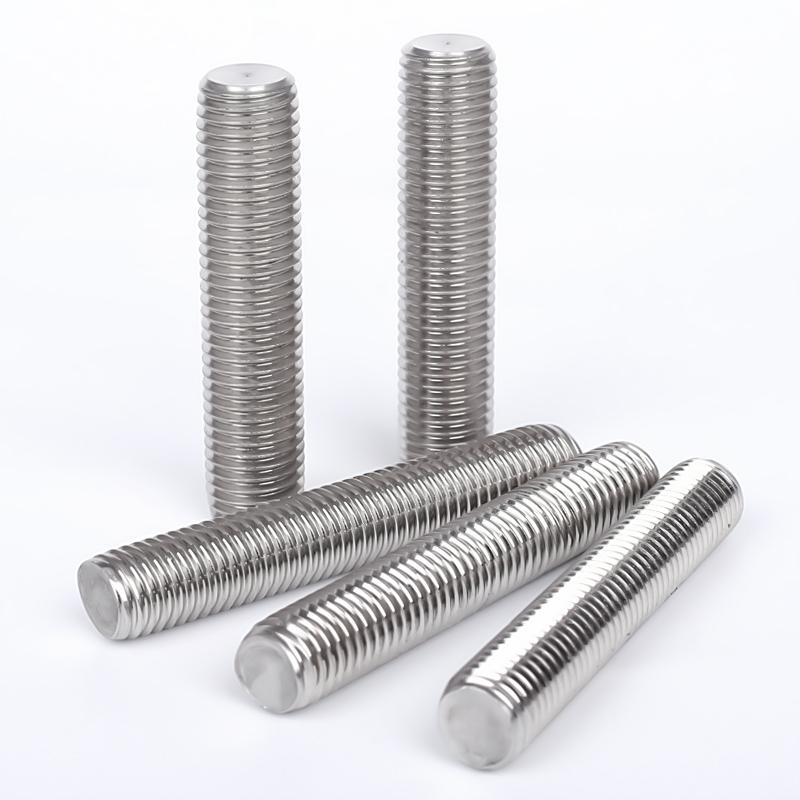
Many engineers treat grade selection as a two-horse race: 304 for general corrosion, 316 when chlorides show up. That habit works until it doesn't. A heat exchanger in coastal service might fail with 316 because the chloride levels exceed its pitting resistance, while a less familiar grade like 317L or 904L would have handled the same environment with far less maintenance. The point isn't that 304 and 316 are bad choices; it's that they represent a starting point, not the full menu.
Look at failure modes before picking a grade. If weld decay is a recurring headache, moving from 316 to 316L or 316Ti makes more sense than adding more corrosion allowance. For high-temperature oxidation or creep, 321 and 347 stabilize carbides and outperform standard austenitics. In brackish water or chemical processing, duplex grades like 2205 offer roughly twice the yield strength of 316 with better chloride stress-corrosion cracking resistance. Choosing a grade by matching the specific attack mechanism—rather than defaulting to a familiar name—often reduces downtime and extends service life.
Cost and availability still matter, but they shouldn't rule the decision. Some engineers avoid higher-alloy grades because they assume they're exotic or hard to source. In reality, many 2205, 317L, and 904L products are stocked by major distributors, and the price premium often looks modest when weighed against a failed 316 component's replacement cost and lost production. A practical approach is to define the operating envelope first—chloride concentration, pH, temperature, mechanical stress—then select the lowest-cost grade that comfortably fits that envelope, even if it's not the one everyone else uses.
Why Standard Threads Fail Under Vibration
Vibration loosens fasteners through a combination of micromotion and loss of preload. Standard threads rely purely on friction between mating surfaces, and when cyclic loading occurs, that friction is gradually overcome. The bolt or nut rotates slightly with each vibration cycle, even if the movement is invisible to the naked eye.
Once preload drops below a critical threshold, the joint no longer clamps parts together effectively. Gaps open and close, allowing impact loads that accelerate loosening. Internal off-torque, caused by relative motion between thread flanks and bearing surfaces, further reduces the remaining clamp force. Without a locking mechanism, the fastener can back off completely over time.
Material relaxation, thermal expansion mismatches, and embedding of surface roughness also contribute to initial preload loss. Combined with vibration, these factors create a runaway condition where standard threads cannot maintain a secure joint. That's why applications subject to dynamic loads demand specialized locking features or thread designs.
Field Cutting Stainless Rods Without Ruining the Finish
Cutting stainless rod on site without wrecking the finish comes down to controlling heat and keeping the surface clean. Wrap the cut zone with a couple layers of painter’s tape before marking your line—this stops the shoe of a portaband or the guard of a grinder from leaving scuffs. If you’re using an angle grinder, switch to a thin 1/16-inch cutoff wheel designed for stainless, and let the tool do the work instead of leaning into it.
For rod up to about half an inch, a handheld tubing cutter with a sharp wheel made for stainless works surprisingly well and leaves almost no burr. On larger diameters, a portaband with a fine-tooth blade (18–24 TPI) is the cleanest portable option. Keep the blade speed moderate and add light cutting fluid or even a squirt of WD-40 to prevent work hardening and blueing around the cut.
After the cut, resist the urge to grab a coarse file right away. Peel off the tape, then use a fine single-cut file or 120-grit emery cloth wrapped around a flat stick to knock down the edge. Finish with a gray Scotch-Brite pad, moving in line with the existing grain, and you’ll keep the factory look without spending an hour polishing out gouges.
Matching Rod Strength to Anchor Pull-Out Loads
Anchor performance hinges on a simple but often overlooked principle: the rod should never be the weak link. When a pull-out load is applied, the anchor transfers stress through the bond into the surrounding material. If the rod yields before that bond fails, you lose capacity that was already paid for in design. The practical starting point is to compare the rod's ultimate tensile strength against the expected pull-out resistance of the anchor system, then apply a safety margin that accounts for installation variability, material creep, and unforeseen eccentric loads.
Field experience shows that mismatches usually appear in one of two directions. A rod that is too light will neck and snap near the anchor plate, leaving the bond zone intact but useless. A rod that is far heavier than the anchor can pull a cone of material out of the substrate, turning a ductile steel failure into a brittle breakout with little warning. The sweet spot lies where the rod's yield strength sits roughly 10–20% below the calculated bond failure load, so the system deforms visibly before reaching ultimate capacity. This allows inspectors to spot distress during periodic checks instead of discovering a sudden collapse.
Beyond raw numbers, thread engagement, shoulder geometry, and corrosion potential shift the balance in ways that pure calculations miss. A high-strength rod mated to a shallow embedment in low-strength concrete may test fine on paper but fail early under cyclic wind or seismic action. Designers who consistently match rod strength to realistic anchor pull-out loads tend to specify slightly oversized anchors with a controlled yielding rod, creating a predictable failure sequence that protects the structure and simplifies replacement after an overload event.
When a Custom Diameter Saves More Than It Costs
In certain mechanical designs, standard diameters may look cheaper on the purchase order, but adaptation and alignment work can quickly eat away those savings. When you're forced to add shims, bushings, or secondary machining to bridge the gap between a shaft and its mating bore, a custom diameter starts to make real sense. A shaft ground to an exact micron tolerance not only eliminates vibration and eccentric loading but also cuts assembly time and field failures.
Another common case is in compact equipment where space is at a premium. Off-the-shelf parts often demand extra support structures or leave unwanted clearance, while a diameter made to your drawing allows components to fit with zero compromise—sometimes even eliminating an entire connecting element. Over the long run, although the per-piece cost is higher, the reduction in maintenance frequency and the gain in system rigidity provide returns that stock items rarely deliver.
FAQ
Stainless steel resists rust through its chromium content rather than a surface coating, so it won't degrade even if scratched or cut during installation.
316 stainless is the go-to because the added molybdenum fights pitting from salt spray; 304 works fine for inland projects where chloride exposure is minimal.
Match the rod diameter to the embedment depth and expected tension, and use a finer thread pitch for vibration-prone joints since it provides more thread engagement per length.
Yes, but after cutting you should passivate the exposed end with a nitric or citric acid gel to restore the protective oxide layer that machining removes.
Apply an anti-seize lubricant made for stainless fasteners and avoid using impact wrenches at full speed; slow, steady torque reduces friction heat that causes galling.
You'll need to verify the rod's tensile and yield strength against the project's specified load requirements, and in some jurisdictions stainless anchors must meet A193 or F593 standards for corrosion-resistant service.
They're commonly used for concrete anchoring, pipe supports, curtain wall attachments, marine docks, and anywhere that moisture, chemicals, or wash-down cleaning would eat standard steel.
Greater embedment depth spreads the load over more threads, reducing pull-out risk; a rule of thumb is to embed at least 8 to 10 thread diameters into solid concrete for full tensile capacity.
Conclusion
Salt-laden coastal air doesn't just dull stainless threaded rods—it initiates pitting and crevice corrosion that quietly chew away load capacity. The usual 304 versus 316 discussion misses the point when chloride exposure is intermittent or when chemical washdowns are part of the job. Leaner duplex grades or molybdenum-bearing variants often outperform both in real coastal and industrial settings, particularly where atmospheric conditions shift between dry heat and heavy salt fog. Vibration is the second silent killer: standard cut threads create stress risers at the root, and once galling or fatigue cracking starts, retightening only masks the damage. Rolled threads with a larger root radius and proper anti-seize compounds hold clamping force far longer under cyclic loading from pumps, conveyors, or wind loads.
Field cutting stainless rod on site usually ends with discolored, rough ends that invite corrosion and make nuts bind. A low-speed bandsaw with a bi-metal blade, followed by a light chamfer and passivation, keeps the protective oxide layer intact—no angle grinder sparks, no blue heat tint. Equally important is matching rod tensile strength to the anchor's pull-out rating rather than defaulting to 'heavier is better.' Oversized rods can overstress embedment or lead to brittle failure modes in the base material. Sometimes a non-standard diameter—say 7/8 inch instead of 1 inch—aligns better with existing hole patterns and load spread, avoiding expensive baseplate rework. The real savings come from reducing field rework, not the rod's unit price.
Contact Us
Contact Person: Shane
Email: [email protected]
Tel/WhatsApp: 8613357785029
Website: https://www.wanluohardware.com