Article Summary: A washing machine pulsator is one of the most important mechanical components in a top-loading washer. By generating controlled water movement and creating a repeated washing action, it helps detergent reach fabrics, separates dirt from clothing, and improves overall cleaning consistency. However, a poorly designed or worn pulsator can lead to weak washing performance, excessive noise, unbalanced operation, fabric damage, or premature component failure. This guide explains how a washing machine pulsator works, what affects its performance, how to select a suitable design, and how manufacturers and replacement-parts distributors can improve reliability through better materials, dimensions, balancing, and quality control.
Article Outline
-
Introduction: The role of the pulsator in top-loading washing machines.
-
Working Principle: How rotational movement becomes effective washing action.
-
Performance: The relationship between water circulation, detergent distribution, and soil removal.
-
Design: Blade geometry, hub construction, balance, dimensions, and surface characteristics.
-
Materials: Why reinforced engineering plastics and metal inserts can improve durability.
-
Maintenance: How users and service teams can identify common pulsator problems.
-
Purchasing: Key specifications for OEM, replacement, wholesale, and aftermarket applications.
-
Quality: Manufacturing and inspection considerations for reliable parts.
-
Conclusion: Selecting a properly engineered pulsator for consistent washing results.
What Is a Washing Machine Pulsator?
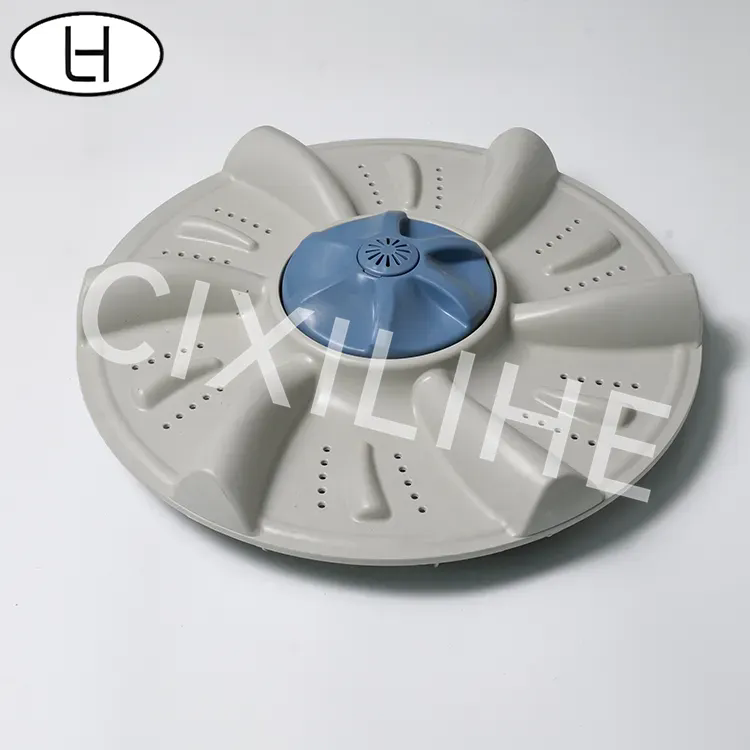
A Washing Machine Pulsator is a rotating or oscillating washing component installed primarily in top-loading washing machines. It is positioned at the bottom of the wash tub and is designed to move water and clothing through a controlled washing pattern.
Unlike a simple rotating plate, a properly engineered pulsator has carefully shaped blades, ribs, channels, and a central mounting structure. These features work together to create water circulation and mechanical movement inside the tub.
The effectiveness of a washing machine depends on many systems, including the motor, transmission, clutch, water level, detergent, wash program, and tub design. The pulsator is the component that directly transfers mechanical movement into the water-and-fabric system. This makes its geometry and durability particularly important.
For appliance manufacturers, a pulsator must do more than simply rotate. It needs to provide repeatable movement, maintain structural integrity during thousands of cycles, fit the intended shaft accurately, and remain stable under changing loads.
How Does a Washing Machine Pulsator Work?
The working principle of a washing machine pulsator is based on mechanical agitation and controlled water circulation. When the drive system activates, torque is transferred to the pulsator through the central mounting structure. The pulsator then moves the water and garments in repeated patterns.
Depending on the washing machine design, the movement may involve continuous rotation, alternating rotation, or another programmed motion. The pulsator's blades push water outward and upward while creating circulation within the tub. Clothing moves through this circulating water, allowing detergent solution to contact different areas of the fabric.
The basic process can be understood as follows:
-
The motor generates mechanical power.
-
The transmission or drive mechanism transfers torque.
-
The pulsator receives the mechanical movement through its hub.
-
Blades and ribs move water around the wash tub.
-
Clothing is repeatedly moved through the detergent solution.
-
Mechanical agitation helps loosen soil from fabric surfaces.
-
The washing program changes movement according to the selected cycle.
This process demonstrates why the pulsator should be treated as a functional mechanical component rather than a decorative plastic part. Small changes in blade angle, height, thickness, hub dimensions, or balance can influence the washing behavior of the entire machine.
What Design Factors Affect Pulsator Performance?
Several engineering factors influence the behavior and service life of a washing machine pulsator. Buyers should evaluate the complete design rather than focusing only on appearance or purchase price.
|
Design Factor
|
Why It Matters
|
Potential Problem if Poorly Designed
|
|
Blade Geometry
|
Controls water movement and agitation.
|
Weak circulation or excessive agitation.
|
|
Hub Structure
|
Transfers torque from the shaft to the pulsator.
|
Slipping, stripping, cracking, or loose operation.
|
|
Overall Dimensions
|
Ensures proper fit inside the washing tub.
|
Installation difficulty or interference.
|
|
Dynamic Balance
|
Helps maintain stable operation.
|
Vibration, noise, and additional mechanical stress.
|
|
Surface Finish
|
Reduces rough contact with fabrics.
|
Fabric snagging or unwanted friction.
|
|
Material Thickness
|
Provides structural support during repeated cycles.
|
Cracking, deformation, or premature failure.
|
These factors are especially important when developing replacement parts. A pulsator may look similar to the original component while having different hub dimensions or blade geometry. Visual similarity alone is therefore not enough to establish compatibility.
Why Do Material Selection and Construction Matter?
A washing machine pulsator operates in a demanding environment. It is repeatedly exposed to water, detergent, mechanical loads, temperature changes, and rotational forces. Material selection therefore directly affects durability and long-term performance.
Engineering plastics are widely used because they can provide a practical combination of strength, low weight, chemical resistance, and manufacturing flexibility. For demanding applications, reinforced formulations can help improve structural stability.
The central hub deserves particular attention. It is the connection point between the pulsator and the drive shaft, meaning that it experiences repeated torque. A weak connection can eventually produce shaft slippage, enlarged mounting holes, deformation, or loss of effective mechanical transmission.
For this reason, some designs incorporate a metal insert into the central mounting area. The insert can provide additional support where torque is concentrated while allowing the main body to retain the advantages of molded engineering material.
Other useful construction considerations include:
-
Appropriate wall thickness for the intended load.
-
Reinforced areas around high-stress mounting points.
-
Smooth contact surfaces to reduce unnecessary fabric interaction.
-
Material resistance to common detergent environments.
-
Consistent molding quality across production batches.
-
Dimensional stability after repeated washing cycles.
The correct material specification should always be matched to the intended washing machine design and operating conditions rather than selected solely according to material cost.
What Problems Can a Worn Pulsator Cause?
Because the pulsator is subjected to repeated mechanical movement, it can eventually show signs of wear. Recognizing these symptoms can help appliance manufacturers, repair technicians, and consumers identify problems before they lead to additional damage.
-
Reduced washing effectiveness: The pulsator may no longer generate the intended water movement.
-
Loose movement: Wear around the hub can prevent effective torque transmission.
-
Unusual noise: Cracks, deformation, imbalance, or mounting problems can increase operating noise.
-
Excessive vibration: An improperly balanced or damaged pulsator may contribute to unstable operation.
-
Visible cracking: Repeated stress or unsuitable material can cause cracks around blades or mounting areas.
-
Surface damage: Rough or damaged surfaces may increase the risk of fabric snagging.
-
Intermittent rotation: A damaged hub can prevent consistent power transfer.
Not every washing problem is caused by the pulsator. Motor faults, clutch problems, transmission issues, excessive loading, foreign objects, and incorrect installation can produce similar symptoms. A proper diagnosis should therefore consider the entire washing system.
How Can Buyers Select the Right Washing Machine Pulsator?
Selecting a compatible pulsator is particularly important for OEM production, appliance repair, aftermarket distribution, and replacement-part businesses. Before ordering, buyers should collect accurate technical information about the target machine.
|
Specification to Check
|
Recommended Information
|
|
Washing Machine Type
|
Top-loading configuration and applicable machine series.
|
|
Load Capacity
|
Target capacity range, such as small, medium, or large household loads.
|
|
Outer Diameter
|
Exact diameter required for the wash tub.
|
|
Hub Dimensions
|
Shaft diameter, mounting depth, and connection configuration.
|
|
Blade Configuration
|
Number, shape, height, and orientation of blades or ribs.
|
|
Material Requirement
|
Required engineering plastic, reinforcement, and application conditions.
|
|
Installation Method
|
Fastener, shaft, insert, or other mounting method.
|
When specifications are uncertain, a technical drawing, sample component, or detailed photographs can make product matching much more accurate. This is particularly useful for older washing machines where original replacement parts may no longer be readily available.
What Quality Checks Should Manufacturers Perform?
A reliable washing machine pulsator requires more than accurate injection molding. Quality control should cover material, dimensions, mechanical behavior, and production consistency.
For example, manufacturers can establish a multi-stage inspection process covering the following areas:
-
Material verification: Confirm that incoming materials meet the specified formulation and production requirements.
-
Dimensional inspection: Measure critical dimensions such as diameter, thickness, hub geometry, and mounting features.
-
Appearance inspection: Check for cracks, deformation, molding defects, sharp edges, and surface irregularities.
-
Balance testing: Verify that the finished component operates without unacceptable imbalance.
-
Mechanical testing: Evaluate the hub and body under representative torque and load conditions.
-
Durability testing: Simulate repeated operating cycles to identify potential fatigue or structural weaknesses.
-
Batch inspection: Monitor finished production to maintain consistency between manufacturing lots.
According to the product information provided by CIXI LIHE, its washing machine pulsators undergo material, dimensional, dynamic balance, and durability verification as part of its quality process. The company also offers different pulsator configurations for various machine capacities and applications.
For buyers, asking about inspection procedures can be more useful than evaluating a product solely from its catalog photograph. Consistency across thousands of components is essential when a part is being used for OEM assembly or large-scale aftermarket distribution.
Where Are Washing Machine Pulsators Used?
Washing machine pulsators serve several commercial and residential applications. The required design can vary depending on the machine structure, capacity, washing program, and target market.
OEM Assembly: Manufacturers can integrate application-specific pulsators into new washing machines.
Replacement Parts: Service companies can use compatible pulsators to restore machines with worn or damaged components.
Aftermarket Distribution: Wholesalers and retailers can supply commonly requested replacement models.
Appliance Maintenance: Repair technicians can replace damaged components during scheduled or corrective service.
Custom Projects: Manufacturers developing specialized machines may require customized dimensions or blade configurations.
CIXI LIHE states that it provides washing machine pulsator options for load capacities ranging from approximately 4 kg to 16 kg and supports standard and customized production.
Why Work With CIXI LIHE?
For buyers sourcing washing machine parts, supplier capability can have a direct impact on product consistency, delivery planning, customization, and long-term procurement stability.
CIXI LIHE, also identified on its product information as Cixi Lihe Electric Appliance Co., Ltd., focuses on washing machine components and has developed washing machine pulsators for OEM, replacement, and aftermarket applications. The company states that it has been involved in this field since 2011.
The manufacturer provides several types of pulsator products, including standard, reinforced, low-noise, high-durability, plastic, and high-efficiency designs. This product variety can be useful when buyers need different specifications for different washing machine models or target markets.
Another important consideration is customization. CIXI LIHE indicates that customers can provide technical drawings, physical samples, or specific design requirements for product development. This approach can help reduce compatibility problems when an existing off-the-shelf part does not meet a particular machine specification.
For international buyers, supplier experience in export packaging, production planning, quality management, and communication can also make the procurement process more predictable.
How Can Pulsator Service Life Be Improved?
Even a well-manufactured pulsator can experience premature wear if the washing machine is overloaded, incorrectly assembled, or operated under unsuitable conditions. Proper use and maintenance can therefore contribute to longer component life.
-
Follow the washing machine's recommended load capacity.
-
Avoid placing hard foreign objects inside the tub.
-
Inspect the pulsator when unusual noise or looseness appears.
-
Check the central mounting area during replacement service.
-
Make sure replacement parts are correctly aligned and securely installed.
-
Inspect for cracks, deformation, or damaged blade surfaces.
-
Use compatible replacement components rather than forcing an incorrect part into position.
-
Investigate excessive vibration instead of continuing to operate a visibly damaged component.
For appliance service providers, maintaining accurate part numbers and dimensional records can also reduce incorrect replacement orders and shorten repair time.
Frequently Asked Questions
FAQ 1
1. What is the main function of a washing machine pulsator?
The main function is to generate mechanical water movement and agitation inside a top-loading washing machine. This movement helps circulate detergent solution and move clothing through the wash water.
2. Is a washing machine pulsator the same as a washing machine agitator?
They are related but not identical designs. A pulsator is generally a disc-like component positioned at the bottom of a top-loading tub, while an agitator commonly refers to a larger central component that moves through the load. The exact terminology can vary by market and washing machine design.
3. How do I know whether a pulsator needs replacement?
Common warning signs include unusual looseness, visible cracks, damaged blades, excessive noise, abnormal vibration, intermittent movement, or a noticeable reduction in washing performance. Other washer components should also be checked before confirming the pulsator as the cause.
4. Can a washing machine pulsator be customized?
Yes. Depending on the manufacturer, customization may include dimensions, hub configuration, blade geometry, material specifications, colors, and other application-specific requirements. CIXI LIHE states that it can develop pulsators based on drawings, physical samples, or customer requirements.
5. What material is commonly used for washing machine pulsators?
Engineering plastics are commonly used because they can offer low weight, molding flexibility, and suitable resistance to the washing environment. Reinforced materials may be selected where higher structural strength is required.
6. Why is the pulsator hub important?
The hub connects the pulsator to the drive shaft and transfers mechanical torque. If the hub becomes worn, cracked, or loose, the pulsator may not receive movement effectively, reducing washing performance.
7. Does pulsator size affect washing performance?
Yes. Diameter, blade height, geometry, and tub clearance all influence water movement and load behavior. The pulsator should therefore be designed specifically for the intended washing machine rather than selected based only on visual similarity.
8. What should OEM buyers provide when requesting a custom pulsator?
Useful information includes technical drawings, samples, shaft dimensions, overall diameter, machine capacity, blade configuration, material requirements, target production quantity, and application conditions. Providing accurate information helps the manufacturer evaluate compatibility and tooling requirements.
9. Why does pulsator balance matter?
An imbalanced component can contribute to vibration, noise, and additional mechanical stress during operation. Dynamic balance inspection can therefore help identify manufacturing or dimensional problems before products reach customers.
10. Can one pulsator fit every washing machine?
No. Pulsators differ in diameter, hub dimensions, blade design, mounting configuration, and application. Compatibility should be confirmed using the machine model and technical specifications.
Conclusion
A washing machine pulsator plays a central role in transforming mechanical power into effective water movement and fabric agitation. Its influence extends beyond basic rotation: blade geometry, hub strength, material selection, dimensional accuracy, surface quality, and dynamic balance can all affect cleaning performance, operating stability, and service life.
For consumers and maintenance professionals, choosing a compatible replacement pulsator can help restore normal washing performance and prevent unnecessary mechanical problems. For OEM manufacturers and distributors, the selection process should go further by evaluating manufacturing consistency, customization capability, quality inspection, material specifications, and long-term supply reliability.
With experience in washing machine components, CIXI LIHE provides a range of pulsator solutions for different washing machine applications and supports customized development based on technical drawings, samples, and customer requirements.
Looking for a reliable Washing Machine Pulsator for OEM production, replacement parts, or aftermarket distribution? Contact CIXI LIHE to discuss your required dimensions, material, blade design, mounting configuration, and production requirements. Contact us for product details, customization support, and a suitable pulsator solution for your application.